

CT Scan Imaging in Colorado Springs
Computed Tomography (CT), also known as a CT scan, is an advanced diagnostic imaging examination that produces detailed cross-sectional images of bones, joints, muscles, blood vessels, and internal structures. At the CSOG Imaging Center, CT scans help orthopaedic physicians evaluate complex fractures, joint conditions, bone abnormalities, spinal disorders, and other musculoskeletal conditions. CT imaging provides detailed information that supports accurate diagnoses and personalized treatment planning.
Accurate Diagnosis
Detailed CT imaging for precise evaluation.
Expert Team
Experienced radiologic professionals you can trust.
Quick & Efficient
Streamlined process for faster results.
Advanced Imaging for Complex Orthopaedic Conditions
When more detailed imaging is needed to diagnose an injury or evaluate a musculoskeletal condition, your physician may recommend a CT scan. At the CSOG Imaging Center, Computed Tomography (CT) provides highly detailed cross-sectional images that help physicians better understand bone and joint anatomy and identify conditions that may not be fully visible on standard X-rays.
CT imaging plays an important role in diagnosing complex fractures, evaluating joint abnormalities, planning orthopaedic procedures, and assessing many conditions affecting the bones and spine.
As part of Colorado Springs Orthopaedic Group, our Imaging Center supports coordinated orthopaedic care by providing the detailed diagnostic information physicians need to develop an effective treatment plan.
What Is a CT Scan?
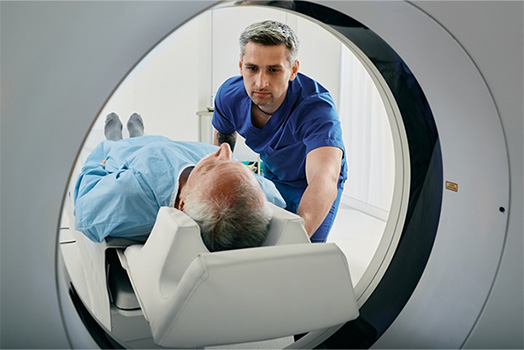
Computed Tomography (CT) is an advanced imaging examination that combines a series of X-ray images taken from multiple angles to create detailed cross-sectional images of the body. These images provide greater anatomical detail than standard X-rays and allow physicians to evaluate bones, joints, and surrounding structures with exceptional clarity.
Depending on your condition, a CT scan may be recommended when additional information is needed following a physical examination or other imaging studies.
What Can a CT Scan Diagnose?
CT imaging is commonly used to evaluate:
- Complex bone fractures
- Joint fractures
- Bone abnormalities
- Degenerative joint disease
- Arthritis
- Bone tumors
- Bone infections
- Certain spinal conditions
- Joint deformities
- Stress fractures
- Healing following fractures
- Surgical planning for orthopaedic procedures
When Might You Need a CT Scan?
Your physician may recommend a CT scan if you have:
- A complex fracture
- Persistent bone or joint pain
- A suspected fracture that requires further evaluation
- Joint deformity
- Arthritis affecting the joints
- Spinal injuries or abnormalities
- A bone lesion or abnormality
- An injury requiring detailed surgical planning
- Symptoms that cannot be fully explained by other imaging studies
Conditions Commonly Evaluated with CT Imaging
Complex Fractures: CT scans provide highly detailed images of fractures involving joints, the pelvis, spine, wrists, ankles, and other areas where precise evaluation is important.
Joint Conditions: CT imaging helps physicians assess joint anatomy, arthritis-related changes, and structural abnormalities affecting joint function.
Spine Disorders: CT scans may be used to evaluate vertebral fractures, degenerative changes, and other conditions affecting the spine.
Surgical Planning: For certain orthopaedic procedures, CT imaging provides detailed anatomical information that assists physicians in planning treatment.
Bone Abnormalities: CT scans help evaluate bone lesions, deformities, and other structural abnormalities that require detailed imaging.
Benefits of CT Imaging
Computed Tomography offers several advantages when evaluating orthopaedic conditions.
- Detailed Cross-Sectional Images: CT scans produce highly detailed images of bones and joints from multiple angles, allowing physicians to evaluate complex anatomy.
- Excellent Bone Detail: CT imaging is particularly valuable for assessing fractures, joint surfaces, and bone abnormalities.
- Fast Examination: Most CT examinations are completed within a relatively short period of time.
- Supports Accurate Diagnosis: The detailed images obtained during a CT scan help physicians diagnose complex conditions and determine the most appropriate treatment plan.
What to Expect During Your CT Scan
During your CT examination:
- You will lie on a motorized examination table.
- The table will move slowly through the CT scanner while images are obtained.
- You may be asked to remain still during the scan.
- Depending on the area being examined, you may be asked to briefly hold your breath.
- Most CT examinations are completed within approximately 10 to 30 minutes.
Preparing for Your CT Scan
Preparation depends on the type of CT examination being performed.
Before your appointment, you should inform your physician and imaging staff if you:
- Are you pregnant or think you may be pregnant
- Have allergies, particularly to contrast material
- Have kidney disease
- Have diabetes
- Take certain medications
- Have had previous reactions to contrast dye
Is a CT Scan Safe?
CT scans use carefully controlled amounts of X-ray radiation to produce detailed diagnostic images. For many orthopaedic conditions, the benefits of obtaining an accurate diagnosis outweigh the potential risks associated with radiation exposure.
Why Choose the CSOG Imaging Center?
At the CSOG Imaging Center, CT imaging is provided as part of a comprehensive orthopaedic care experience.
Patients benefit from:
- Advanced diagnostic imaging
- Experienced imaging professionals
- Imaging focused on musculoskeletal conditions
- Collaboration between imaging professionals and orthopaedic specialists
- Comprehensive diagnostic evaluation
- Patient-centered care
- Convenient Colorado Springs locations
CT Scan Services Through CSOG
CT examinations at the CSOG Imaging Center are performed as part of your orthopaedic evaluation and treatment plan. If your CSOG provider determines that a CT scan is appropriate, they will recommend the examination to obtain additional diagnostic information and help guide your care.
Frequently Asked Questions
CT scans are commonly used to evaluate complex fractures, bone abnormalities, joint conditions, spinal disorders, and other musculoskeletal conditions that require more detailed imaging than a standard X-ray.
No. CT imaging is painless and non-invasive. You will simply need to remain still while the images are being acquired.
Some CT examinations require contrast material to improve image detail, while others do not. Your physician will determine whether contrast is appropriate based on your condition.
CT scans are particularly useful for evaluating bones, complex fractures, and detailed bone anatomy, while MRI provides greater detail of soft tissues such as muscles, ligaments, tendons, cartilage, and nerves. Your physician will recommend the imaging study that best answers the clinical question.
While both use X-rays, a CT scan captures multiple images from different angles and combines them to create detailed cross-sectional views of the body, providing much greater anatomical detail.
Most CT examinations take approximately 10 to 30 minutes, depending on the area being examined and whether contrast material is required.
Yes. CT scans use carefully controlled amounts of radiation and are considered safe when medically appropriate. Your physician recommends a CT scan only when the diagnostic benefits outweigh the potential risks.
CT Scan Locations
South Colorado Springs CT Scans
1655 Quail Lake Loop
Colorado Springs, CO 80906
CT Direct Phone:
Direct Fax:
Email: [email protected]
Schedule Your CT Scan
If your physician recommends a CT scan, the CSOG Imaging Center provides advanced imaging services to support accurate diagnosis and comprehensive orthopaedic care.
Working closely with your orthopaedic provider, our imaging team helps deliver the detailed diagnostic information needed to plan the most appropriate treatment for your condition.
Contact the CSOG Imaging Center to learn more about our CT imaging services or discuss your upcoming examination.


